

T
he super shoe revolution started with one shoe. The Nike Vaporfly 4 carries that legacy forward in 2026 with some of the biggest updates the lineup has seen. However, at a retail price of $260, one question remains: does a carbon-plate shoe actually make you faster, and is this version worth the investment?
Here’s the honest, data-backed answer.
What Changed From Version 3 To Version 4
The Flyplate angle has increased from 15 degrees to 20 degrees. As a result, the shoe creates a stronger teeter-totter effect that pushes runners onto their toes more aggressively.
Additionally, the stack height has dropped to 35mm in the heel and 29mm in the forefoot. Although this sounds like a downgrade, it actually delivers a sharper ride during shorter and faster efforts.
The Upper Overhaul
The Vaporfly 4 replaces the Flyknit upper with a lighter and tighter engineered mesh. Nike also swaps the asymmetrical lacing for a traditional setup, making the fit more familiar.
In addition, the company introduces a new molded footbed instead of the flat insole found in previous versions. Moreover, the shorter tongue helps eliminate the lace-bite issue that many Vaporfly 3 owners experienced.
Nike Vaporfly 4 Review: How It Actually Feels On The Road
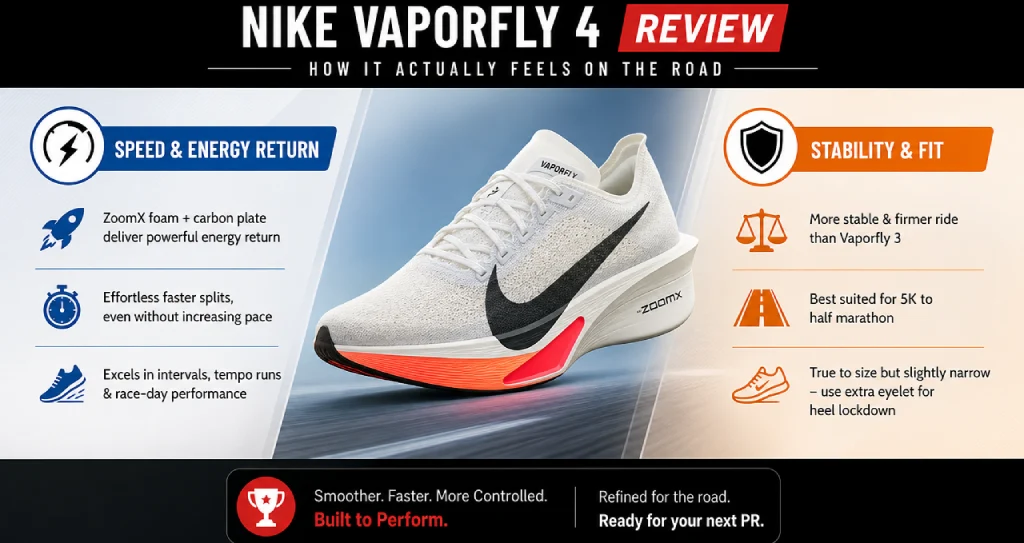
Speed And Energy Return
The ZoomX foam remains the heart of this shoe, and it still delivers impressive energy return.
Without intentionally increasing the pace, testers recorded splits that were nearly a minute faster per mile. That’s the advantage of combining ZoomX foam with a carbon plate.
Furthermore, the Vaporfly 4 excels during faster workouts. It performs especially well for track intervals, strides, marathon-pace sessions, and long tempo runs.
That said, runners expecting a dramatic leap over the Vaporfly 3 may feel underwhelmed. Instead, this version offers a smoother and more refined ride. It feels more natural while remaining better suited to shorter race distances.
The competition has also caught up at the elite level. Even so, most recreational runners will still notice a meaningful speed advantage.
Stability And Fit
The updates make the Vaporfly 4 more aggressive and direct than the Vaporfly 3. Many runners felt the previous version was too soft, but the latest model provides a firmer and more controlled ride.
As a result, it feels most comfortable for races between 5K and the half marathon.
Moreover, the Vaporfly 4 offers noticeably better stability than its predecessor. It combines explosive energy return with a more planted platform.
The fit runs true to size. However, the shoe is slightly narrow, and some testers noticed mild heel slippage.
Therefore, using the extra eyelet for heel lockdown is highly recommended before your first run.
Are Carbon-Plate Shoes Worth It For Regular Runners?
The Performance Reality
Carbon-plate shoes genuinely improve running economy for many runners. The original 2017 Vaporfly 4% demonstrated this with lab testing that showed roughly a 4% improvement in running economy.
However, the results vary from runner to runner. A shoe that works exceptionally well for one athlete may provide only modest benefits for another.
In addition, carbon-plate shoes perform best at faster speeds. The Vaporfly 4 feels most effective during high-intensity efforts of around 4:30 min/km or faster. It also rewards runners who naturally land on the forefoot or midfoot.
If you usually run at slower training paces, the performance gains become much smaller.
Durability Concerns
Durability remains the biggest compromise.
The exposed ZoomX foam creases early, and the outsole tends to collect debris during runs.
Additionally, Nike redesigned the outsole with waffle-inspired blown rubber lugs. These improve grip and durability compared to previous models.
Even with these upgrades, the Vaporfly 4 remains a dedicated race-day shoe rather than a daily trainer.
Final Thoughts
The Nike Vaporfly 4 deserves its place among the best carbon-plate racing shoes of 2026.
Overall, the 13% weight reduction, steeper Flyplate angle, and refined upper make it the most complete Vaporfly yet. It is especially impressive for 5K, 10K, and half marathon racing.
Finally, runners who compete regularly and want genuine performance gains will find the Vaporfly 4 worth its premium price.
On the other hand, casual runners or those who spend most of their time at easy training paces will likely get better long-term value from a premium daily trainer.

