

W
alk into any running store and you’ll find a wall of Brooks on one side and a wall of HOKA on the other.Both brands are popular, both have loyal followings, and both make shoes that plenty of runners swear by.Yet they feel quite different on the foot, and choosing between them is rarely about which one is “better.” It’s about what kind of ride you want.
This guide breaks down the real differences: where each brand comes from, how the shoes feel, how they handle stability and fit, how long they last, and who tends to prefer which. Along the way, I’ve pointed out places where reviewers disagree, because on a few details they do.
Two Very Different Backstories
Brooks is the old-timer. According to Wikipedia, it was founded in 1914 in Philadelphia by John Brooks Goldenberg, who bought the Quaker Shoe Company, a maker of ballet slippers and bathing shoes. For decades it made shoes for all sorts of sports. That changed in 2001, when the company cut its product line by more than half to focus entirely on running. Forbes Vetted notes that the brand really hit its stride in running in 1972, when an American won the Olympic marathon in a pair of Brooks. Today it’s based in Seattle, and its best-known shoe, the Ghost, has been around since 2008.
HOKA is the newcomer. It was founded in 2009 in Annecy, France, by Nicolas Mermoud and Jean-Luc Diard, and Deckers Brands acquired it in 2013, according to Wikipedia. The name reportedly means “to fly” in Maori, and the company is now based in Goleta, California. Unlike Brooks, HOKA started out as a running brand, with an emphasis on helping athletes cover longer distances, often on trails.
That history helps explain the personalities of the two brands. Brooks reads as steady and traditional. HOKA reads as bold and a little futuristic.
The Ride: Soft And Rolling Vs. Balanced And Steady

If there’s one difference you’ll feel right away, it’s the cushioning.
HOKA shoes are known for thick, soft midsoles.Combined with a rocker-shaped sole, which HOKA calls the Meta-Rocker, this gives the shoes a distinctive feel:soft underfoot, with a gentle push forward at toe-off. Ringly puts it well, saying the maximal stack and Meta-Rocker make it feel like the ground is doing some of the work.
Brooks takes a different approach. Its shoes are still comfortable, and some models are plush, but the feel is more balanced and more connected to the ground. Several comparisons describe Brooks cushioning as firmer and more stable than HOKA’s, which many runners prefer for control and longevity.One roundup from Runner’s Lab says Brooks has soft models but “nowhere near the level of Hoka,” while noting that Brooks has focused on stable shoes that work for different gaits.
In everyday terms: if you want to feel cushioned and carried, HOKA tends to deliver. If you want comfort without feeling like you’re on a pillow, Brooks tends to suit you better.
Heel Drop And Geometry
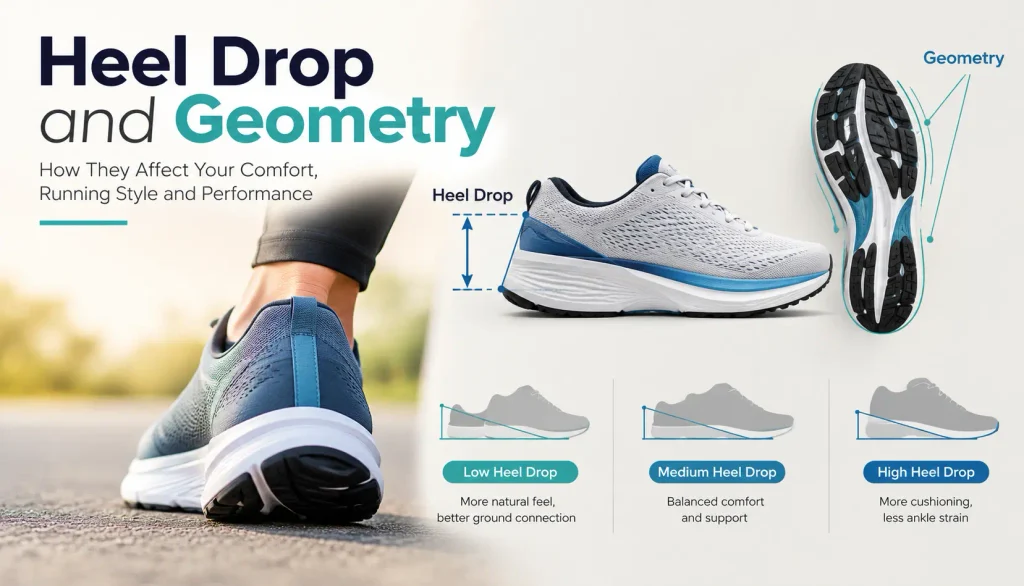
Heel drop is the height difference between the heel and the forefoot, and it changes how a shoe feels.
Brooks has traditionally used a higher drop. One comparison from Care Focus Daily says most Brooks shoes land between 10 and 12 mm, matching conventional running shoe geometry. Forbes lists the Ghost 17 at 10 mm.HOKA shoes tend to sit lower, commonly in the 5 to 8 mm range, depending on the model and the source you check. Ringly lists the Clifton at 8 mm, while an older comparison lists the Clifton 9 at 5 mm.
That low drop, combined with the rocker shape, encourages a rolling stride. Care Focus Daily suggests HOKA’s rocker can be helpful for achy joints, while Brooks’ higher drop tends to suit heel strikers.These are generalizations rather than rules, and your own stride matters more than any label.
Cushioning Technology
Both brands have signature foams, and the names come up constantly in reviews.
Brooks’ main cushioning is DNA LOFT, which RunBikeCalc describes as a nitrogen-infused foam that is soft yet responsive. Other Brooks foams include BioMoGo DNA and DNA Flash, which are used in lighter shoes. HOKA relies mostly on compression-molded EVA foam and, in some models, a PROFLY midsole, which is softer in the heel and firmer in the forefoot.
The practical result is that HOKA tends to feel plusher at first, while Brooks’ denser foam holds its shape for longer.
Stability
Both brands make stability shoes for runners whose feet roll inward, but they go about it differently.
Brooks is generally seen as the stronger stability brand. Its GuideRails system, according to Forbes, places firmer foam on both sides of the heel to prevent excess inward or outward movement. The Adrenaline GTS is the best-known example, and the Beast is its motion-control sibling, which has been around since 1992 according to Wikipedia.
HOKA’s stability shoes, like the Arahi and Gaviota, use frames built into the midsole, such as the J-Frame in the Arahi and the H-Frame in the Gaviota. They also rely on a wide base to stay planted. A comparison from OnClouder says HOKA’s emphasis leans more toward plush comfort than rigid support, and that Brooks shines in this category.
If you overpronate and want a shoe that guides your foot, Brooks is the more traditional choice. If you want mild stability in a softer ride, HOKA’s options are worth a look.
The Daily Trainers Up Close: Ghost Vs. Clifton

Since most people start with one of these two, it’s worth looking at them side by side. RunBikeCalc’s comparison lists the Ghost as using DNA LOFT foam with a subtle rocker, while the Clifton uses compression-molded EVA with a pronounced Meta-Rocker. Forbes describes the Ghost 17 as a neutral shoe with jacquard mesh, DNA LOFT v3 foam, and a 10 mm drop.
On the road, that translates to a Ghost that feels familiar and predictable, and a Clifton that feels softer and keeps you moving forward.Neither is wrong. They just answer different questions: do you want a shoe that stays out of the way, or one that does a little of the work for you?
Stability Matchup: Adrenaline GTS Vs. Arahi
The stability pair is similar. An older comparison from Find My Footwear lists the Adrenaline GTS 23 at about 10.1 oz with a 12 mm drop and GuideRails support, against the Arahi 6 at about 9.3 oz with a 5 mm drop and a J-Frame. That’s a big difference in geometry, and it’s a good reminder that two shoes in the same category can feel quite different. The Adrenaline offers a more structured ride, while the Arahi gives you support in a softer package.
Fit And Sizing
This is one area where sources disagree, so it’s worth trying shoes on.
Ringly says HOKA tends to have a roomier toe box. Care Focus Daily says the opposite, noting that Brooks tends toward a roomier toe box that suits swelling during long runs.Both could be true for different models, since toe box shape varies a lot even within a brand.
What’s easier to pin down is width. Brooks offers a wide range of widths on many models, including 2E and 4E on some, while HOKA offers fewer wide options, according to a ShopBack comparison. If you have wide feet, check the exact model’s available widths before you commit.
Durability
Both brands are rated for roughly 300 to 500 miles, according to Ringly. But Ringly adds that HOKA’s lighter, softer foam tends to compress faster, while Brooks’ denser DNA LOFT holds its shape closer to the top of that range.
Keep in mind that these numbers come from review sites rather than lab tests. Your weight, running surface, and stride all affect how quickly a shoe wears out, and the best sign that it’s time to replace a pair is when it stops feeling like it did.
What About Weight?
Weight is a mixed picture. In the same older comparison, the Clifton 9 came in lighter than the Brooks Ghost Max (about 8.7 oz versus 10 oz), and the Arahi was lighter than the Adrenaline GTS. But the Brooks Hyperion GTS, a lightweight stability trainer, weighed slightly less than the HOKA Mach 5 (7.9 oz versus 8.2 oz). So neither brand is consistently lighter.It depends on which two shoes you’re comparing.
Price
The two are close. Ringly lists HOKA at roughly $150 to $170 and Brooks at $140 to $150 for daily trainers. Premium and lightweight models run higher for both brands. An older comparison from Find My Footwear listed the Brooks Ghost Max at $190 against the HOKA Clifton 9 at $180. In general, HOKA is sometimes a little more expensive, but the gap isn’t big enough to decide for most people.
Model-By-Model Matchups
If you’re comparing specific shoes, these are the usual pairings:
| Category | Brooks | HOKA |
|---|---|---|
| Daily trainer | Ghost | Clifton |
| Max cushion | Glycerin | Bondi |
| Stability | Adrenaline GTS | Arahi |
| Motion control | Beast | Gaviota |
| Lightweight | Hyperion | Mach |
Model names and numbers change every year or two, so use these as a starting point and check the current versions.
Walking And Everyday Wear
Plenty of people buy both brands for walking or long days on their feet, not just running. The same cushioning difference applies: HOKA tends to feel softer and more protective, while Brooks feels more grounded and stable.If you’re mostly walking, trying both on in the afternoon, after you’ve been on your feet, will tell you more than any spec sheet.
Who Should Choose Which
Choose HOKA if you want the softest, most protective ride, you like a rolling feel, or you want a cushioned shoe for recovery days and long, slow runs. Many runners with sore joints gravitate toward HOKA, though that’s a personal preference, not medical advice.
Choose Brooks if you want a steadier, more traditional feel, you need dependable stability, you have wide feet, or you tend to run on the heel and prefer a higher drop.
If you’re unsure, both brands have safe, well-reviewed daily trainers. The Brooks Ghost and the HOKA Clifton are the standard starting points, and either one is a reasonable first pair.
Tips For Buying
A few habits help whichever brand you pick:
- Try shoes on later in the day, when your feet are a bit swollen.
- Leave about a thumb’s width of space in front of your longest toe.
- Jog a few steps in the store, or test them on a treadmill if possible.
- Consider a gait analysis at a specialty running store if you’re not sure whether you need stability.
- Replace shoes before they’re completely worn out, since cushioning fades before the outsole does.
If you have ongoing pain in your feet, knees, or shins, it’s worth seeing a podiatrist or physical therapist rather than relying on shoes alone.
Where The Sources Disagree
It’s only fair to say that reviewers don’t agree on everything.Toe box room, heel drop numbers, and mileage estimates differ from one site to the next, and some comparisons are a few years old. Shoes update often, so the model reviewed last year may not be the one on shelves now.Treat spec comparisons as a guide, and trust how the shoe feels on your own foot.
The Bottom Line
The main difference between Brooks and HOKA comes down to feel.HOKA gives you a soft, rolling, heavily cushioned ride. Brooks gives you a balanced, steady one with a stronger stability lineup and more width options.Neither is better across the board.The best choice is the shoe that feels right on your foot during a short run, and the easiest way to find out is to try both.

